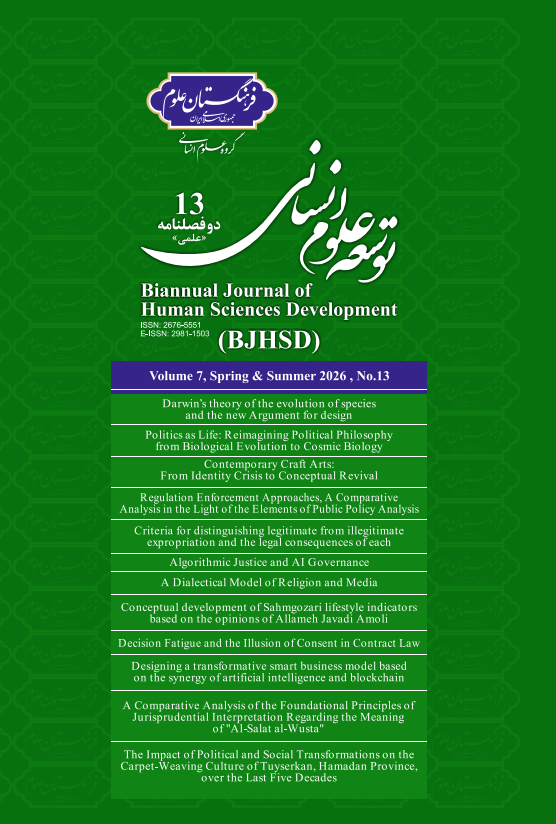
Algorithmic Justice and AI Governance: An Analysis of Legal and Technical Challenges alongside Mechanisms for Transparency and AccountabilityAlgorithmic Justice and AI Governance: An Analysis of Legal and Technical Challenges alongside Mechanisms for Transparency and Accountability

Document Type : Original Article

Authors
1 Assistant Professor, Faculty of Law, University of Religions and Denominations
2 PhD student in Public International Law, Islamic Azad University, Qeshm, Iran
3 PhD student in private law, University of Religions and Denominations,, Qom, Iran
10.22047/hsd.2026.543632.1101
Abstract
The rapid expansion of algorithms and artificial intelligence (AI) systems in legal, economic, and social decision-making processes has raised serious questions about justice, transparency, and accountability. Algorithmic justice refers to ensuring fair and non-discriminatory decision-making within AI systems. With the increasing reliance on algorithms in sensitive decision-making contexts, concerns regarding biases embedded in data and system design have intensified. The central research question of this paper is: How can algorithmic justice be realized within the framework of AI governance through legal and technical mechanisms of transparency and accountability? To address this question, a descriptive–analytical method was employed, and data were collected through a literature review and comparative analysis of international instruments, regional regulations (such as the European Union’s frameworks), and technical scholarship in machine learning and AI.The findings indicate that achieving algorithmic justice requires three fundamental pillars: first, the development of explainable and bias-resistant technologies that enable oversight and evaluation of algorithmic decisions; second, the establishment of binding legal frameworks alongside soft-law guidelines emphasizing impartiality, transparency, and users’ right to contest decisions; and third, the strengthening of regulatory bodies and international cooperation for drafting common standards of data and algorithm governance. Furthermore, the results show that accounting for cultural and social diversity, together with educating legal and technological actors, constitutes a prerequisite for public acceptance and the effective implementation of algorithmic justice.
Keywords

2.        Angwin, J., Larson, J., Mattu, S., & Kirchner, L. (2016). Machine Bias. ProPublica. P:1-11.

3.        Binns, R. (2018). Fairness in machine learning: Lessons from political philosophy. Proceedings of the 2018 Conference on Fairness, Accountability, and Transparency (FAT* ’18), 149–159. https://doi.org/10.1145/3287560.3287598

4.        Barocas, S., & Hardt, M. (2016). Fairness in Machine Learning. In Proceedings of the 2016 Conference on Fairness, Accountability, and Transparency (FAT)*. P:1-167.

5.        Barocas, S., & Nissenbaum, H. (2014). Big Data’s End Run around Anonymity and Consent. In J. Lane, V. Stodden, S. Bender, & H. Nissenbaum (Eds.), Privacy, Big Data, and the Public Good: Frameworks for Engagement (pp. 44-75). Cambridge University Press.

6.         Barocas, S., & Selbst, A. D. (2016). Big Data’s Disparate Impact. California Law Review, 104(3), 671-732.

7.        Binns, R. (2018). Fairness in Machine Learning: Lessons from Political Philosophy. Proceedings of the 2018 Conference on Fairness, Accountability, and Transparency. P:149-159.

8.        Bloch‑Wehba, Hannah. (2022). Algorithmic Governance from the Bottom Up. BYU Law Review, Vol. 48, p. 69.

9.        Chen, L. (2020). Algorithmic Fairness in Asian Legal Contexts. Asian Journal of Law and Society, 7(2), 233-255.

10.      Crawford, K., Whittaker, M., Dobbe, R., Fried, G., Kaziunas, E., Mathur, V., ... & Schwartz, O. (2018). AI Now Report 2018. AI Now Institute. P:1-44.

11.      European Commission. (2019). Ethics Guidelines for Trustworthy AI.

12.      Floridi, L., Cowls, J., King, T. C., & Taddeo, M. (2018). How to Design AI for Social Good: Seven Essential Factors. Science and Engineering Ethics, 24(3), 1-13.

13.      Friedman, B., & Nissenbaum, H. (1996). Bias in Computer Systems. ACM Transactions on Information Systems, 14(3), 330-347.

14.      Goodman, B., & Flaxman, S. (2017). European Union regulations on algorithmic decision-making and a "right to explanation". AI Magazine, 38(3), 50-57.

15.      IEEE. (2020). IEEE 7000-2020 - Standard for Ethically Aligned Design.

16.      ISO. (2020). ISO/IEC 27001:2013 Information technology — Security techniques — Information security management systems — Requirements.

17.      Kamiran, F., & Calders, T. (2012). Data preprocessing techniques for classification without discrimination. Knowledge and Information Systems, 33(1), 1-33.

18.      Kearns, M., & Roth, A. (2020). The Ethical Algorithm: The Science of Socially Aware Algorithm Design. Oxford University Press. P:1-232.

19.      Mehrabi, N., Morstatter, F., Saxena, N., Lerman, K., & Galstyan, A. (2021). A survey on bias and fairness in machine learning. ACM Computing Surveys, 54(6), Article 115, 1-35. https://doi.org/10.1145/3457607

20.      Mulligan, D. K., Zalnieriute, M., Daly, A., & Gellert, R. (2019). Articulating the values of data protection: progress and problems. International Data Privacy Law, 9(2), 135-148.

21.      OECD. (2019). Recommendation of the Council on Artificial Intelligence. OECD Publishing.

22.      O’Neil, C. (2016). Weapons of Math Destruction: How Big Data Increases Inequality and Threatens Democracy. Crown Publishing Group. P:1-272.

23.      Pasquale, F. (2015). The Black Box Society: The Secret Algorithms That Control Money and Information. Harvard University Press. P:1-320.

24.      PDPA. (2012). Personal Data Protection Act. Singapore.

25.      Rawls, J. (1971). A theory of justice (p. 11). Harvard University Press.

26.      Ribeiro, M. T., Singh, S., & Guestrin, C. (2016). “Why Should I Trust You?”: Explaining the Predictions of Any Classifier. Proceedings of the 22nd ACM SIGKDD International Conference on Knowledge Discovery and Data Mining. P:1-10.

27.      Rowe, E. A., & Prior, N. (2022). Procuring Algorithmic Transparency. Alabama Law Review. P: 303–364.

28.      Russell, S. J., & Norvig, P. (2021). Artificial Intelligence: A Modern Approach (4th ed.). Pearson. P:1-11.

29.      Selbst, A. D., Boyd, D., Friedler, S. A., Venkatasubramanian, S., & Vertesi, J. (2019). Fairness and Abstraction in Sociotechnical Systems. In Proceedings of the Conference on Fairness, Accountability, and Transparency (pp. 59-68). ACM.

30.      Stern, R. E., Liebman, B. L., Roberts, M., & Wang, A. Z. (2021). Automating Fairness? Artificial Intelligence in the Chinese Court. Columbia Law School Scholarship Archive. P:515-553.

31.      US Congress. (2019). Algorithmic Accountability Act of 2019. H.R. 2231.

32.      Woods, Andrew Keane. (2022/2023). Robophobia. University of Colorado Law Review, Vol. 93, No. 1, pp. 51–114.

33.      Weller, A. (2019). Transparency: Motivations and Challenges. In T. K. Seppälä, S. Poutanen, & A. R. Harju (Eds.), Digital Transformation and Ethics (pp. 23-39). Springer International Publishing.

34.      Zuboff, S. (2019). The Age of Surveillance Capitalism: The Fight for a Human Future at the New Frontier of Power. PublicAffairs.P:1-704.
منابع:
1.      انصاری، باقر (1401). مطالعه حقوقی تبعیض الگوریتمی، فصلنامه دانش حقوق عمومی، سال یازدهم، زمستان، شماره 38، صفحات: 178-147.
2.        Angwin, J., Larson, J., Mattu, S., & Kirchner, L. (2016). Machine Bias. ProPublica. P:1-11.
3.        Binns, R. (2018). Fairness in machine learning: Lessons from political philosophy. Proceedings of the 2018 Conference on Fairness, Accountability, and Transparency (FAT* ’18), 149–159. https://doi.org/10.1145/3287560.3287598
4.        Barocas, S., & Hardt, M. (2016). Fairness in Machine Learning. In Proceedings of the 2016 Conference on Fairness, Accountability, and Transparency (FAT)*. P:1-167.
5.        Barocas, S., & Nissenbaum, H. (2014). Big Data’s End Run around Anonymity and Consent. In J. Lane, V. Stodden, S. Bender, & H. Nissenbaum (Eds.), Privacy, Big Data, and the Public Good: Frameworks for Engagement (pp. 44-75). Cambridge University Press.
6.         Barocas, S., & Selbst, A. D. (2016). Big Data’s Disparate Impact. California Law Review, 104(3), 671-732.
7.        Binns, R. (2018). Fairness in Machine Learning: Lessons from Political Philosophy. Proceedings of the 2018 Conference on Fairness, Accountability, and Transparency. P:149-159.
8.        Bloch‑Wehba, Hannah. (2022). Algorithmic Governance from the Bottom Up. BYU Law Review, Vol. 48, p. 69.
9.        Chen, L. (2020). Algorithmic Fairness in Asian Legal Contexts. Asian Journal of Law and Society, 7(2), 233-255.
10.      Crawford, K., Whittaker, M., Dobbe, R., Fried, G., Kaziunas, E., Mathur, V., ... & Schwartz, O. (2018). AI Now Report 2018. AI Now Institute. P:1-44.
11.      European Commission. (2019). Ethics Guidelines for Trustworthy AI.
12.      Floridi, L., Cowls, J., King, T. C., & Taddeo, M. (2018). How to Design AI for Social Good: Seven Essential Factors. Science and Engineering Ethics, 24(3), 1-13.
13.      Friedman, B., & Nissenbaum, H. (1996). Bias in Computer Systems. ACM Transactions on Information Systems, 14(3), 330-347.
14.      Goodman, B., & Flaxman, S. (2017). European Union regulations on algorithmic decision-making and a "right to explanation". AI Magazine, 38(3), 50-57.
15.      IEEE. (2020). IEEE 7000-2020 - Standard for Ethically Aligned Design.
16.      ISO. (2020). ISO/IEC 27001:2013 Information technology — Security techniques — Information security management systems — Requirements.
17.      Kamiran, F., & Calders, T. (2012). Data preprocessing techniques for classification without discrimination. Knowledge and Information Systems, 33(1), 1-33.
18.      Kearns, M., & Roth, A. (2020). The Ethical Algorithm: The Science of Socially Aware Algorithm Design. Oxford University Press. P:1-232.
19.      Mehrabi, N., Morstatter, F., Saxena, N., Lerman, K., & Galstyan, A. (2021). A survey on bias and fairness in machine learning. ACM Computing Surveys, 54(6), Article 115, 1-35. https://doi.org/10.1145/3457607
20.      Mulligan, D. K., Zalnieriute, M., Daly, A., & Gellert, R. (2019). Articulating the values of data protection: progress and problems. International Data Privacy Law, 9(2), 135-148.
21.      OECD. (2019). Recommendation of the Council on Artificial Intelligence. OECD Publishing.
22.      O’Neil, C. (2016). Weapons of Math Destruction: How Big Data Increases Inequality and Threatens Democracy. Crown Publishing Group. P:1-272.
23.      Pasquale, F. (2015). The Black Box Society: The Secret Algorithms That Control Money and Information. Harvard University Press. P:1-320.
24.      PDPA. (2012). Personal Data Protection Act. Singapore.
25.      Rawls, J. (1971). A theory of justice (p. 11). Harvard University Press.
26.      Ribeiro, M. T., Singh, S., & Guestrin, C. (2016). “Why Should I Trust You?”: Explaining the Predictions of Any Classifier. Proceedings of the 22nd ACM SIGKDD International Conference on Knowledge Discovery and Data Mining. P:1-10.
27.      Rowe, E. A., & Prior, N. (2022). Procuring Algorithmic Transparency. Alabama Law Review. P: 303–364.
28.      Russell, S. J., & Norvig, P. (2021). Artificial Intelligence: A Modern Approach (4th ed.). Pearson. P:1-11.
29.      Selbst, A. D., Boyd, D., Friedler, S. A., Venkatasubramanian, S., & Vertesi, J. (2019). Fairness and Abstraction in Sociotechnical Systems. In Proceedings of the Conference on Fairness, Accountability, and Transparency (pp. 59-68). ACM.
30.      Stern, R. E., Liebman, B. L., Roberts, M., & Wang, A. Z. (2021). Automating Fairness? Artificial Intelligence in the Chinese Court. Columbia Law School Scholarship Archive. P:515-553.
31.      US Congress. (2019). Algorithmic Accountability Act of 2019. H.R. 2231.
32.      Woods, Andrew Keane. (2022/2023). Robophobia. University of Colorado Law Review, Vol. 93, No. 1, pp. 51–114.
33.      Weller, A. (2019). Transparency: Motivations and Challenges. In T. K. Seppälä, S. Poutanen, & A. R. Harju (Eds.), Digital Transformation and Ethics (pp. 23-39). Springer International Publishing.
34.      Zuboff, S. (2019). The Age of Surveillance Capitalism: The Fight for a Human Future at the New Frontier of Power. PublicAffairs.P:1-704.
Volume 7, Issue 13 - Serial Number 13
Humanities
Volume 7, Spring and Summer 2026, No. 13
October 2026
Pages 95-117

Supplementary File