Contemporary Craft Arts: From Identity Crisis to Conceptual Identity (With an Emphasis on Howard Becker's Sociology of Art and Craft Theory)

Document Type : Original Article

Authors
1 phd
2 Assistant Professor, Faculty of Crafts, Tabriz Islamic Art University (TIAU), Tabriz, Iran
Abstract
Craft (handicrafts), which in the past constituted a synthesis of skill, taste, and social function, faced a fundamental crisis and a limitation of efficacy in the face of the Industrial Revolution. Adopting an analytical-comparative approach, this article traces the evolution of craft from early reactions (such as the Arts and Crafts Movement) to their contemporary configurations (studio craft and craftivism). Drawing upon Howard Becker's sociological framework (particularly the concept of 'craft' and its transition to 'art'), as well as theoretical approaches in contemporary craft studies (such as material agency, embodied skill, and social activism), this paper examines the semi-autonomous and interstitial identity of craft arts within the contemporary art system. In doing so, while emphasizing that in the Iranian artistic-craft tradition, artistic intention and execution have never been separated, and that the interweaving of faith, ethics, and skill with artisanal products has provided a distinct, indigenous ground for redefining the identity of contemporary craft, this article—by applying the aforementioned theoretical foundations to the situation of Iranian craft, particularly ceramics—demonstrates how this field, while maintaining its connection to tradition, has on the one hand entered the realm of visual/conceptual arts, and on the other hand, by preserving its material and process-oriented nature, has transformed into a tool for critical expression and social action (craftivism).
Keywords

- Adamson, G. (2018). Fewer, better things: The hidden wisdom of objects. USA: Bloomsbury Publishing.
- Crevels, Eric, 2022. Coarse epistemes: Skill, craftsmanship and tacit knowledge in the grit of the world, In book: Tacit Knowledge in Architecture.
- Aktaş, Bilge Merve; Mäkelä, Maarit. 2019. Negotiation between the Maker and Material: Observations on Material Interactions in Felting Studio, International Journal of Design, Vol 13, No 2.
- Ryle, G. (1976). Improvisation. Mind, 85(337), pp.69-83
- Malafouris, L. (2013). How things shape the mind: A theory of material engagement. Cambridge, MA: MIT.
- Ingold, Tim. (2013). Making: Anthropology, Archaeology, Art and Architecture. London: Routledge. https://doi.org/10.4324/9780203559055.
- Ingold, Tim. (2002).  “On Weaving a Basket.” In The Perception of the Environment: Essays on Livelihood, Dwelling and Skills, 339–61. London: Routledge.
- Ingold, Tim. (2009). “The Textility of Making.” Cambridge Journal of Economics 34, no. 1: 91–102. https://doi.org/10.1093/cje/bep042.
- Kuijpers, Maikel H. G. (2018).  An Archaeology of Skill: Metalworking Skill and Material Specialization in Early Bronze Age Central Europe. New York: Routledge. https://doi.org/10.4324/9781315196022.
- Polanyi, Michael. (1967). The Tacit Dimension. London: Routledge & Kegan Paul.
- Sennett, R. (2009). The Craftsman. Penguin Books.
- Nimkulrat, N. and Groth, C. (2024). Craft and Design Practice from an Embodied Perspective (p. 238). Taylor & Francis.
- Lo, K. J. (2015). Authenticity in Craft: Investigating Material Authenticity in Contemporary Craft Practice (Unpublished doctoral thesis). Heriot-Watt University, UK.
- Oddy, Nicholas. (2016). Truth to Materials, In book: The Bloomsbury Encyclopedia of Design. DOI:10.5040/9781472596154-BED-ONLINE-033
URLS:
- Truth to materials:
- The Concept of “Truth to Materials”:
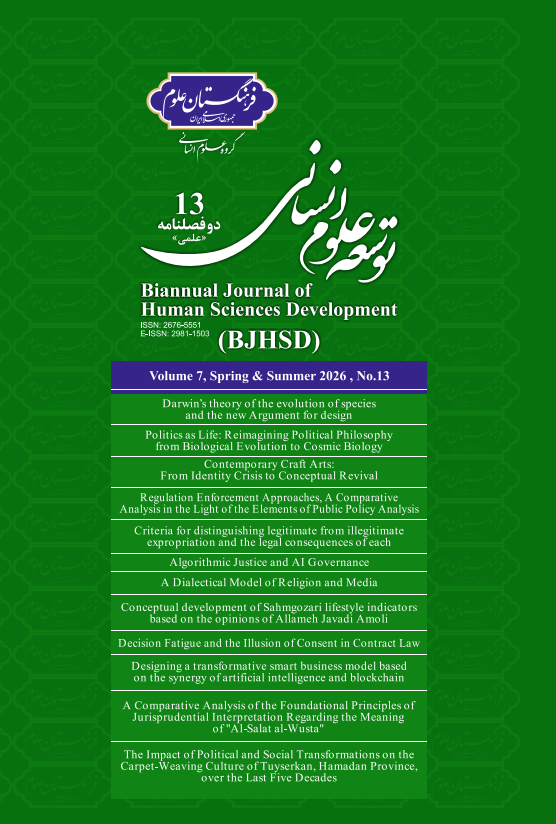
Volume 7, Issue 13 - Serial Number 13
Humanities
Volume 7, Spring and Summer 2026, No. 13
October 2026
Pages 31-46

Supplementary File